


.svg)

EU ETS Compliance Cost
Read the full detailed analysis here.
Since 2024, the EU Emissions Trading System covers the maritime sector. Starting in 2026, 100% of tank-to-wake CO₂, CH₄, and N₂O emissions must be surrendered. For an industry built on thin margins and long voyages, this raises a critical question: what does compliance really cost — and what drives it?
The Challenge
Quantifying EU ETS compliance cost is not straightforward. It depends on a web of interdependent variables — vessel specifications, engine type, journey distance, EUA prices, and exposure rules that differ between EU-to-EU (100%) and EU-to-non-EU (50%) voyages. Without a structured framework, market participants risk mispricing compliance obligations and underestimating their impact on trading portfolios.
Our Approach
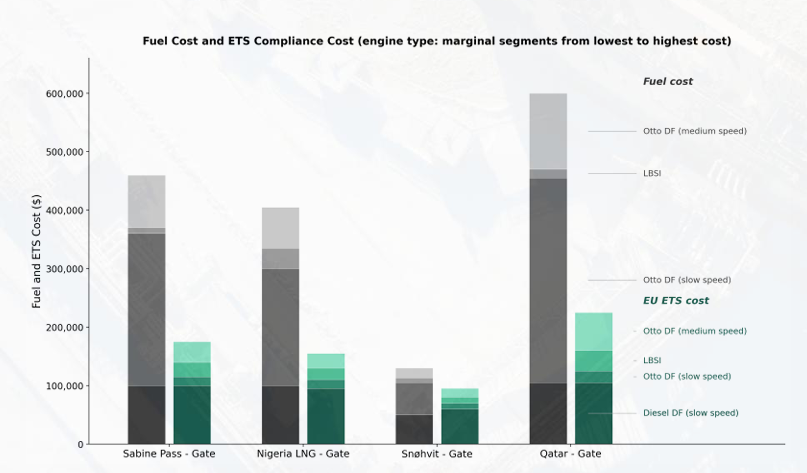
We analyzed four representative LNG journeys — all arriving at Gate Terminal (Rotterdam) — from Sabine Pass (US), Nigeria LNG, Snøhvit (Norway), and Qatargas (Qatar). Each journey was modeled across four engine types using a 174,000 m³ Neopanamax vessel (~3.8M MMBtu), benchmarked at €85/EUA. We applied the EU ETS compliance cost formula — Fuel Consumption × Emissions Factor × EUA per Unit Cost × Exposure — and isolated each cost driver independently:
- EUA index sensitivity across all four routes to quantify how price fluctuations flow through to compliance cost
- Four engine types to isolate the impact of fuel efficiency and GHG intensity on total exposure
- Speed sensitivity between 16–19 knots to measure the compliance cost of faster transit
- Per-MMBtu compliance cost by distance to benchmark route economics on a traded-unit basis
Key Insights
1) Compliance cost is real — but manageable: One-way EU ETS costs range from ~€50K (Norway) to ~€200K (Qatar). A tangible OPEX item, but not a portfolio-breaker at current EUA prices.
2) Engine choice is the biggest lever: Compliance cost varies by up to 60% across the four engine types analyzed. Fuel efficiency and GHG intensity make vessel selection a direct compliance cost decision.
3) Distance drives per-unit cost: Per-MMBtu compliance cost ranges from ~1¢ (Norway) to ~15¢ (Qatar). Shorter routes mean less fuel burned per unit of LNG delivered.
4) Proximity beats exposure rate: Despite 100% EU ETS exposure, Norwegian cargoes remain the cheapest per MMBtu — proximity to Rotterdam outweighs the higher regulatory exposure of 50%-exposed long-haul routes.
5) Speed adds ~20% cost uplift: Between 16 and 19 knots, compliance cost rises roughly €20K–€30K one-way — a meaningful variable in voyage economics.
Key Takeaways
→ EU ETS compliance cost is a dynamic, market-driven variable — not a fixed line item. It directly impacts vessel OPEX and trading P&L.
→ With EUA supply expected to tighten 19% by 2030, prices are likely to rise — amplifying costs across all routes and engine types.
→ Engine efficiency, journey planning, and EUA hedging now interact directly with trading competitiveness. Integration into fleet deployment and charter negotiations is no longer optional — it is a competitive necessity.
→ The regulatory trajectory is clear: the EU ETS cap tightens 4.3% annually through 2027 and 4.4% through 2030, with ~27 million fewer EUAs entering the market in 2026 alone. FuelEU Maritime (2025) and the IMO Net Zero Framework add further layers. Compliance cost optimization will be a defining factor in LNG trading competitiveness over the coming years.
.svg)
Legal Notice
Impressum
Angaben gemäß § 5 TMG
Calypso Ventures GmbH
Bismarckstraße 10/12
10625 Berlin
Handelsregister: HRB 239736 B
Amtsgericht Charlottenburg
Umsatzsteuer: DE342781749
Vertreten durch:
Michael Schach
Kontakt
Telefon: +49 30 41734423
E-Mail: support@calypso-commodities.com
Nutzungsvereinbarungen
Imprint
Disclosures according to German law § 5 TMG
Calypso Ventures GmbH
Bismarckstraße 10/12
10625 Berlin
Registered number: HRB 239736 B
Amtsgericht Charlottenburg (Germany)
VAT: DE342781749
Represented by:
Michael Schach
Contact
Phone: +49 30 41734423
E-Mail: support@calypso-commodities.com
User Agreements
EU ETS Compliance Cost
Read the full detailed analysis here.
Since 2024, the EU Emissions Trading System covers the maritime sector. Starting in 2026, 100% of tank-to-wake CO₂, CH₄, and N₂O emissions must be surrendered. For an industry built on thin margins and long voyages, this raises a critical question: what does compliance really cost — and what drives it?
The Challenge
Quantifying EU ETS compliance cost is not straightforward. It depends on a web of interdependent variables — vessel specifications, engine type, journey distance, EUA prices, and exposure rules that differ between EU-to-EU (100%) and EU-to-non-EU (50%) voyages. Without a structured framework, market participants risk mispricing compliance obligations and underestimating their impact on trading portfolios.
Our Approach
We analyzed four representative LNG journeys — all arriving at Gate Terminal (Rotterdam) — from Sabine Pass (US), Nigeria LNG, Snøhvit (Norway), and Qatargas (Qatar). Each journey was modeled across four engine types using a 174,000 m³ Neopanamax vessel (~3.8M MMBtu), benchmarked at €85/EUA. We applied the EU ETS compliance cost formula — Fuel Consumption × Emissions Factor × EUA per Unit Cost × Exposure — and isolated each cost driver independently:
- EUA index sensitivity across all four routes to quantify how price fluctuations flow through to compliance cost
- Four engine types to isolate the impact of fuel efficiency and GHG intensity on total exposure
- Speed sensitivity between 16–19 knots to measure the compliance cost of faster transit
- Per-MMBtu compliance cost by distance to benchmark route economics on a traded-unit basis
Key Insights
1) Compliance cost is real — but manageable: One-way EU ETS costs range from ~€50K (Norway) to ~€200K (Qatar). A tangible OPEX item, but not a portfolio-breaker at current EUA prices.
2) Engine choice is the biggest lever: Compliance cost varies by up to 60% across the four engine types analyzed. Fuel efficiency and GHG intensity make vessel selection a direct compliance cost decision.
3) Distance drives per-unit cost: Per-MMBtu compliance cost ranges from ~1¢ (Norway) to ~15¢ (Qatar). Shorter routes mean less fuel burned per unit of LNG delivered.
4) Proximity beats exposure rate: Despite 100% EU ETS exposure, Norwegian cargoes remain the cheapest per MMBtu — proximity to Rotterdam outweighs the higher regulatory exposure of 50%-exposed long-haul routes.
5) Speed adds ~20% cost uplift: Between 16 and 19 knots, compliance cost rises roughly €20K–€30K one-way — a meaningful variable in voyage economics.
Key Takeaways
→ EU ETS compliance cost is a dynamic, market-driven variable — not a fixed line item. It directly impacts vessel OPEX and trading P&L.
→ With EUA supply expected to tighten 19% by 2030, prices are likely to rise — amplifying costs across all routes and engine types.
→ Engine efficiency, journey planning, and EUA hedging now interact directly with trading competitiveness. Integration into fleet deployment and charter negotiations is no longer optional — it is a competitive necessity.
→ The regulatory trajectory is clear: the EU ETS cap tightens 4.3% annually through 2027 and 4.4% through 2030, with ~27 million fewer EUAs entering the market in 2026 alone. FuelEU Maritime (2025) and the IMO Net Zero Framework add further layers. Compliance cost optimization will be a defining factor in LNG trading competitiveness over the coming years.
Legal Notice
Impressum
Angaben gemäß § 5 TMG
Calypso Ventures GmbH
Bismarckstraße 10/12
10625 Berlin
Handelsregister: HRB 239736 B
Amtsgericht Charlottenburg
Umsatzsteuer: DE342781749
Vertreten durch:
Michael Schach
Kontakt
Telefon: +49 30 41734423
E-Mail: support@calypso-commodities.com
Nutzungsvereinbarungen
Imprint
Disclosures according to German law § 5 TMG
Calypso Ventures GmbH
Bismarckstraße 10/12
10625 Berlin
Registered number: HRB 239736 B
Amtsgericht Charlottenburg (Germany)
VAT: DE342781749
Represented by:
Michael Schach
Contact
Phone: +49 30 41734423
E-Mail: support@calypso-commodities.com
User Agreements